21 September

The Origin of the Pentateuch. Part 2. Jerusalem


Hypotheses and the Silence about Jerusalem

The hypotheses I mentioned in Part One regarding the origin of the first five books of the Bible all share one common feature: they assume that the main parts of the Pentateuch were written in Jerusalem. Scholars differ only in the period and circumstances of composition. However, within the Pentateuch itself there is not a single (!) mention of Jerusalem. And this is quite strange.

The narratives unfold in other cities and regions of Palestine. The authors tell of the origins of various cultic sites, the histories of certain towns, and the etymology of some geographical names. Yet they never once mention Jerusalem. If the stories of the Pentateuch had been written in Jerusalem, one would expect their authors to show interest in Jerusalem’s history—perhaps in the stories of the patriarchs or in the conquest of Canaan. But nothing of the kind is observed. The authors stubbornly ignore Jerusalem.

This fact troubled many biblical commentators, who have offered various explanations. I will highlight a few of them.

20 September

Textual Criticism of Ancient Texts: The Origin of the Pentateuch. Part 1. Hypotheses


Canonical Version

For many centuries it has been believed that the first five books of the Old Testament were written by the prophet Moses. However, only one of them (the fifth book, Deuteronomy) is written in the first person. Most likely, the canonical claim of Mosaic authorship of all five books developed gradually. Initially, it referred only to Deuteronomy, and then it was extended to all five books, despite the fact that the first four are written in the third person and contain no direct claim that they were written by Moses.

Today, the hypothesis of Mosaic authorship of the entire Pentateuch is supported by believers, theologians, and those for whom the Bible is not merely a book but the direct word of God.

Scholarly Hypotheses

Since the Middle Ages, biblical commentators have criticized the idea of Mosaic authorship. They noticed numerous problematic passages in the books, which indicated that:

  • The Pentateuch could not have been written by one person, because it contains too many contradictions, duplicate stories, and variations in phraseology.

  • It could not have been written in the desert, but rather in Palestine, where the Israelites had already lived for some time.

  • It could not have been written during the time of Moses, since it contains hints that a long period had passed between Moses’ era and the time of writing.

18 November

Research Reveals Ancient Struggle over Holy Land Supremacy

By Matthias Schulz


The Jews had significant competition in antiquity when it came to worshipping Yahweh. Archeologists have discovered a second great temple not far from Jerusalem that predates its better known cousin. It belonged to the Samaritans, and may have been edited out of the Bible once the rivalry had been decided.
More

08 August

Samaritan Letter to Artaxerxes the King

According to the fourth chapter of the Book of Ezra Zerubbabel, the leader of the Jews, has refused the Samaritan’s help in rebuilding the Temple in Jerusalem. Offended, the Samaritans began to interfere with the Jews in rebuilding the temple and seduce the king's officials to stop construction of the temple. Later, they wrote a letter to the Persian king Artaxerxes with denunciation of the Jews. In it Samaritans warned the king that if rebuilding of the temple and the city of Jerusalem would complete the Jews will raise revolt and stop paying tribute. In support of his words the senders of the letter asked the king of search in the royal archives of old documents from which it can verify the rebellious nature of the Jews. After receiving and reading the letter King Artaxerxes has raised the old documents and saw that message senders were right. In response Artaxerxes ordered a prohibition rebuild Jerusalem and its temple. As a result the construction of the temple has been stopped all the reign of Artaxerxes until the next reign of Darius king of Persia. This storyline draws us to the fourth chapter of the Book of Ezra.

30 July

The Qumran Excavations 1993-2004. Preliminary report. Summary

Yitzhak Magen and Yuval Peleg
Jerusalem 2007

Much has been written about Qumran, and endless theories have been proposed, some of which have attained the status of fact upon which archaeological research has built over the past fifty years. Here, we wish to clearly distinguish between various hypotheses concerning the site and the archaeological evidence that we have exposed in our excavations.

The first settlement at Qumran was established in the Iron Age. When the site was again inhabited in the Hasmonean period it was built in exactly the same place. This fact itself, together with an analysis of the topography and of the water regime of the area, provide clear evidence that this was the optimal—and perhaps the only—location on the upper plateau of the marl terraces next to the fault scarp in which a settlement would not be swept away by floods and would be able to collect flowing water and potters' clay. The claim that the location was chosen because of its isolation, for the purpose of establishing a first Jewish monastery or a community center for the Judean Desert sect, is groundless.

24 July

The Samaritan Version of Deuteronomy and the Origin of Deuteronomy

Prof. Dr. Stefan Schorch
Martin-Luther-Universität Halle-Wittenberg

Since 1953, when Albrecht Alt’s famous essay “Die Heimat des Deuteronomiums” was published, the question about the historical origin of Deuteronomy became an important issue in the research on the Hebrew Bible. Pointing especially to conceptual parallels between Deuteronomy and the Book of Hosea, Alt argued that Deuteronomy was not composed in Judah or in Jerusalem, but in the North. Although this suggestion has been followed by important experts of Deuteronomy, Alt’s theory is today far from being generally accepted among Old Testament scholars. One of the main reasons for this situation seems to be one weak point: Alt’s study offers no explanation for how the idea of cult centralization, which is so prominently expressed in Deuteronomy (especially in chapters 12, 14, and 16), fits in the geographical context of Israel. Therefore, this issue seems to be worth reconsideration, and this will be the main focus of the following article.

The idea of cult centralization appears for the first time in Deut 12:5:

You shall seek the place that the LORD your God will choose out of all your tribes (םכיטבש לכמ םכיהלא הוהי רחבי רשא םוקמה) as his habitation to put his name there. You shall go there…

This or similar formulae appear in the Book of Deuteronomy no less than 22 times. From the perspective of the received Masoretic text as a whole, the chosen place is clearly identified within the so-called Deuteronomistic history. Accordingly, the chosen place is Jerusalem, as expressed in the extant narrative for the first time in 1 Kgs 8:16 (LXX//2 Chr 6:5‒6):

23 July

The Composition of the Pentateuch in Recent Research: A Teaching and Study Resource

John E. Anderson

I.  Introduction
a.  A lack of consensus in the last 30 years of scholarship
b.  Both diachronic and synchronic approaches, documentarian and supplementarian approaches
c.  To understand where we are, it is important—briefly—to look at from where we have come

II.  Precursors to the Documentary Hypothesis: Working Towards JEDP (emergent source-criticism)
a.  Spinoza (1670): “it is thus clearer than the sun at noonday that the Pentateuch was not written by Moses, but by someone who lived longer after Moses” (also Hobbes)
b.  Jean Astruc (1753): isolates in Genesis an E and J source, with other independent material (yet did not challenge Mosaic authorship; Moses as redactor)
c.  Wilhelm Martin Leberecht de Wette (1780-1849) – decisive new phase in Pentateuchal investigations.
i.  Saw religious institutions in Chronicles as retrojection from time of writing in late Persian / early Hellenistic period
1.  thus reasonable that Pentateuchal legal material dates from time after monarchy
2.  Pentateuchal narrative traditions cannot be used as historical source material
ii.  1805 – identified law book discovered by Josiah as early version of Deuteronomy (dates to 7th century)
d.  H. Hupfeld (1853): in Genesis, identifies earlier E strand (corresponding to P) and later one; also an even later J document
e.  K.H. Graf (1860s): Hupfeld’s E1 = Priestly and is latest, not earliest source (also Reuss prior and Kuenen after re-dating)
f.  Julius Wellhausen (Prolegomena to the History of Israel)
i.  J & E = earliest sources; not always clearly distinguishable by use of divine names
1.  combined by a Jahwistic editor
ii.  Q (quattuor, four covenants) provides basic chronological structure for P material fitted in
iii.  P
1.  ritual law in Holiness Code (Leviticus 17-26), which is dependent on Ezekiel
2.  thus P is the latest stage in editorial history of 5x/6x, save for some late Deuteronomic retouchings
iv.  Deuteronomy
1.  comes into existence independent of other sources
2.  622 with Josiah = first edition
3.  familiar with JE but not P, so combined with JE prior to P ® JEDP
4.  end result = publication of Pentateuch in final form at the time of Ezra (5th century)
v.  Reveals an evolutionary view of Israelite religion (sees Moses as at end rather than beginning of historical process)
1.  JE = nature religion, spontaneous worship arising in daily life and festivals tethered to agrarian calendar
2.  D = centralization of worship, ends spontaneity, seals prophecy with emphasis on written law
3.  P = denatured religion dominated by clerical caste that remade past in own image
vi.  This view of sources dominated largely for nearly a century

19 July

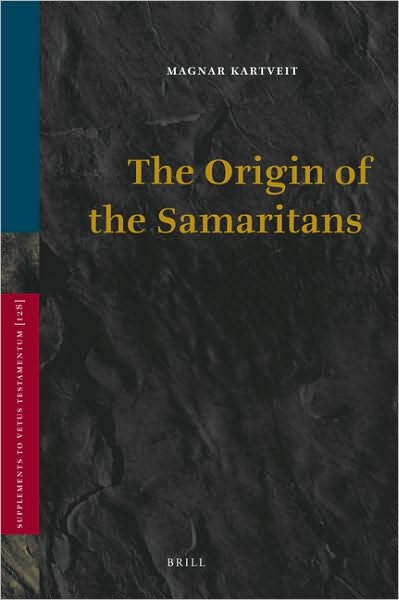
The Origin of the Samaritans

By Magnar Kartveit

Many Bible readers will think that chapter 17 of the second book of Kings refers to the origin of the Samaritans. According to the Authorized Version we read about “the Samaritans” in verse 29, and a number of translations reveal the same understanding. On closer inspection, however, it turns out that 2Kgs 17:29 does not refer to the Samaritans, but to the “people of Samaria,” whose relation to the Samaritans is not immediately clear.

The understanding of 2Kgs 17 as dealing with the Samaritans has its earliest attestation in the works of Josephus. He offers a story where he describes them as “Chouthaioi,” a group which was brought by the Assyrian king Salmanasser from “Chouthas” in Persia into Samaria after the occupation and subsequent depopulation of that area, Ant. 9.278f., 288–291.This version takes us back to the eighth century B.C.E., and it has led scholars and lay people to believe that the Samaritans were deportees from the East, brought into Samaria in this early period; in Samaria they remained through the ages, and perhaps they mixed with the local population—a situation which most likely resulted in syncretism. The story resembles 2Kgs 17 and this has led to reading the chapter as referring to the origin of the Samaritans.

31 May

Laying the Foundations of Jerusalem Temple by Zerubbabel


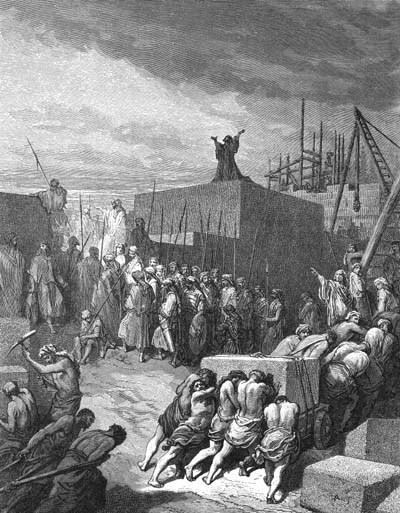
Third chapter of Ezra book tells us how after the return from Babylon the Jews led by Zerubbabel and Joshua built an altar and restored the sacrifice to God Yahweh. After celebration of religious holidays they began to rebuild the temple.

First, they brought wood from Lebanon according to the order of King Cyrus. The priests began construction of the temple and laid its foundations. After laying the foundations the priests and Levites with trumpets and cymbals began to praise the Lord and to thank him for establishing the foundations of the temple. There were also the people who have seen the previous temple of Solomon by their own eyes. They wept for joy and someone just loudly rejoiced. This noise has been heard by Samaritans who wanted to participate in the reconstruction of the temple. But Zerubbabel refused them. Consequently, Samaritans began to interfere with the Jews to build the temple and its rebuilding has been delayed from the reign of King Cyrus until the reign of King Darius.

Premature celebration

In the plot line of this story about laying the foundations of the temple there is a confusing thing. For what did the Jews celebrate so joyfully with trumpets and cymbals? For what did they so grateful to God? What did the elders compare with the previous Solomon Temple? According to the storyline of Ezra book, they merely laid the foundation but rejoiced as if the temple has already been built.

23 May

Did God Have a Wife? Archaeology and Folk Religion in Ancient Israel (pdf)

This is a book about ordinary people in ancient Israel and their everyday religious lives, not about the extraordinary few who wrote and edited the Hebrew Bible. It is also a book for ordinary people today who know instinctively that "religion" is about experience, not about the doctrines of scholars, theologians, and clerics who study religion dispassionately and claim authority. My concern in this book is popular religion, or, better, "folk religion" in all its variety and vitality.

This is a book that, although it hopes to be true to the facts we know, does not attempt objectivity; for that is impossible and perhaps even undesirable. One can understand religion only from within, or at least from a sympathetic viewpoint. As an archaeologist, I shall try to describe the religions of ancient Israel — not theoretically, from the top down, as it were, but practically, "from the bottom up," from the evidence on the ground.

This is a book mostly about the practice of religion, not about belief, much less theology. It is concerned with what religion actually does, not with what religionists past or present think that it should do. Beliefs matter, for they are the wellspring of action; and theological formulations may be helpful or even necessary for some. But archaeologists are more at home with the things that past peoples made, used, and discarded or reused, and what these artifacts reveal about their behavior, than they are with speculations about what these people thought that they were doing. As Lewis Binford reminds us, "archaeologists are poorly equipped to be paleo-psychologists."

The Bible Unearthed. Archaeology's New Vision of Ancient Israel and the Origin of Its Sacred Texts (pdf)

Prologue. In the Days of King Josiah

The world in which the Bible was created was not a mythic realm of great cities and saintly heroes, but a tiny, down-to-earth kingdom where people struggled for their future against the all-too-human fears of war, poverty, injustice, disease, famine, and drought. The historical saga contained in the Bible—from Abraham's encounter with God and his journey to Canaan, to Moses' deliverance of the children of Israel from bondage, to the rise and fall of the kingdoms of Israel and Judah—-was not a miraculous revelation, but a brilliant product of the human imagination. It was first conceived—as recent archaeological findings suggest—during the span of two or three generations, about twenty-six hundred years ago. Its birthplace was the kingdom of Judah, a sparsely settled region of shepherds and farmers, ruled from an out-of-the-way royal city precariously perched in the heart of the hill country on a narrow ridge between steep, rocky ravines.

During a few extraordinary decades of spiritual ferment and political agitation toward the end of the seventh century ВСЕ, an unlikely coalition of Judahite court officials, scribes, priests, peasants, and prophets came together to create a new movement. At its core was a sacred scripture of unparalleled literary and spiritual genius. It was an epic saga woven together from an astonishingly rich collection of historical writings, memories, legends, folk tales, anecdotes, royal propaganda, prophecy, and ancient poetry. Partly an original composition, partly adapted from earlier versions and sources, that literary masterpiece would undergo further editing and elaboration to become a spiritual anchor not only for the descendants of the people of Judah but for communities all over the world.

04 May

The Story of Zerubbabel (Origin of the Guards Story)

One of the main characters of the biblical Book of Ezra is Zerubbabel. He heads the list of exiles that returned from the Babylonian captivity. After returning core group of exiles in the reign of the Persian king Cyrus Zerubbabel led the process of rebuilding the Temple in Jerusalem, he built an altar and laid the foundations of the temple. Despite the various obstacles Zerubbabel along with other exiles finished building the temple in the sixth year of the reign of Darius the King.

However, the book didn't disclose the figure of Zerubbabel absolutely. Who was he? How did he become the leader of Jews? For what achievements? What is its fate?

Zerubbabel in the Book of Haggai

The book of Haggai gives us some information about this hero. But this information is largely contrary to the events of the book of Ezra. The book of Haggai tells us that Zerubbabel was governor of Judea at the time of king Darius. In those days people lived in Judea, but their life was uncomfortable. The land gave poor yields. Then God Yahweh through the prophet Haggai addressed the Jews and explained them that the reason of calamity is that the people of Judah didn’t rebuild the temple of God in Jerusalem. If they would rebuild it God will bless the land and it will give generous yields. Then residents of Judea led by the governor Zerubbabel began to build the temple and a few weeks they resumed it in the second year of the reign of king Darius.

21 April

List of Exiles Who Returned from Babylonian Captivity

In Ezra 2 there is a list of people who returned from Babylon to Judah by order of the Persian king Cyrus. In the list it is given the heads of Jews, division of people by genealogy, division of local origin, division of the profession. There is given total number of captives, the number of cattle and slaves. After returning to Judah the people donated gold and silver for the reconstruction of the temple and settled in their cities. The following start of the temple building described in the next chapter of the book.


Textual problems

This list is also located in the Book of Nehemiah and in 1 Esdras. Moreover, 1 Esdras states that these exiles returned not at the time of King Cyrus, but at the time of King Darius. These three versions contain significant differences. They are different genealogies, numbers in groups, the number of donated money, the number of animals, the replacing of some groups. These discrepancies are chaotic in nature. Only part of them can be explained by errors of copyists. Therefore impossible to determine what list is original and what is derived from the original list.

The list indicated the total number of captives, which are 42,360 people. But in none of the lists in both books of Ezra and Nehemiah the total number of people does not exceed 34,000 people. Thus the lists are incomplete in all three books, the total number of listed exiles is 30000 - 34000 people.

18 April

Le Seigneur choisira-t-il le lieu de son nom ou l’a-t-il choisi? L’apport de la Bible Grecque ancienne á l’histoire du texte Samaritain et Massorétique

Adrian Schenker

1. La formule du Deutéronome : Le lieu que le Seigneur a choisi pour y établir son nom

L’étude d’un point particulier d’histoire du texte de la Bible hébraïque à la lumière de la Bible grecque ancienne est dédiée en hommage cordial à la collègue éminente Madame Raija Sollamo dont les echerches ont contribué si magnifiquement à la connaissance de la Bible grecque des Septante. Il s’agira d’une formule deutéronomique bien connue, différente dans la Bible massorétique et samaritaine. Qu’en est-il de son attestation dans la Bible grecque ancienne ? La formule elle-même se rencontre en trois formulations légèrement différentes 21 fois dans le Deutéronome. Voici la première forme : « le lieu que le Seigneur choisira (texte massorétique,  tm) ou a choisi (Pentateuque samaritain [Sam]) pour y faire habiter son nom». Elle se trouve six fois en Dt 12 : 11 ; 14 : 23 ; 16 : 2,6,11 ; 26 : 2. La deuxième forme est la suivante: « le lieu que le Seigneur choisira (tm) ou a choisi (Sam) pour y placer son nom ». Elle est attestée deux fois en Dt 12 : 21 ; 14 : 24. En Dt 12 : 5, les deux formes se cumulent : « le lieu que le Seigneur choisira (tm) ou a choisi (Sam) pour y placer son nom et le faire habiter ». La troisième forme n’a pas de complément d’infinitif et se borne à constater le choix que le Seigneur fait du lieu : « le lieu que le Seigneur choisira (tm) ou a choisi » (Sam). Le Deutéronome s’en sert douze fois en 12 : 14,18,26 ; 14 : 25 ; 15 : 20 ; 16 : 7,15,16 ; 17 : 8,10 ; 18 : 6 ; 31 : 11. D’autres éléments comme l’épithète « ton Dieu » ou «parmi toutes les tribus» peuvent entrer dans la formule. Il n’est pas nécessaire de s’y arrêter ici.

16 April

How Does One Date an Expression of Mental History? The Old Testament and Hellenism

Niels Peter Lemche, 
Professor of Department of Biblical Exegesis
Faculty of Theology
University of Copenhagen

In the good days of old—not so far removed from us in time—a biblical text was usually dated according to its historical referent. A text that seemed to include historical information might well belong to the age when this historical referent seemed likely to have existed. At least this was the general attitude. The historical referent was the decisive factor. If the information included in the historical referent was considered likely or even precise, the text that provided this information was considered more or less contemporary with the event—that is, the historical referent—although the only source of this event was often the text in question that referred to it.

In those days, everybody knew and talked about the 'hermeneutic circle'. It was generally accepted that the study of ancient Israel was from a logical point of view based on a circellus logicus vitiosum, a false logical circle, but nobody within biblical studies believed that it was possible to avoid this logical trap.

16 January

The Story of Sheshbazzar

The book of Ezra tells us how after 70 years of Babylonian captivity the Jewish people returned to Judah and rebuilt Jerusalem temple. Rebuilding of the temple was quite complex process. Due to various circumstances the rebuilding of the temple in Jerusalem permanently delayed. Starting at the first year of the Persian king Cyrus the rebuilding of the temple ended only in the sixth year of Darius the king.

In the first chapter of the book (so called Story of Sheshbazzar) the Persian king Cyrus the Great issued an order and allowed the Jews return to Judah and rebuild the temple of Yahweh in Jerusalem. Then Cyrus sent to Jewish ruler Sheshbazzar the temple vessels which Nebuchadnezzar king of Babylon brought from the temple of Solomon before its destruction. In the following chapters of the book is given a list of people who returned from captivity and described the beginning of the process of rebuilding the temple. But in following chapters nothing is said about Sheshbazzar. In the next chapters of this book the main characters are Zerubbabel the governor, Joshua the high priest and Ezra the scribe later. Nothing is said about what happened with temple vessels which the Persian king Cyrus gave Sheshbazzar through his treasurer Mithredath. Consequently, the book contains a puzzle. Whither did Sheshbazzar disappear? And where did he put the temple vessels that he brought from Babylon?

21 December

Aspects of Samaria’s Religious Culture During the Early Hellenistic Period

Gary N. Knoppers 

In the first volume of his extensive study, A History of the Jews and Judaism in the Second Temple Period, Grabbe comments that a number of peculiar problems confront the would-be historian in attempting to write about the Persian period. Among these are the survival of few primary (contemporary) documents, the types of extant written sources, large gaps in the available sources, and the fact that most narrative descriptions written about this era in antiquity are late works in Greek or Latin, presenting events from a Hellenic or Roman perspective. When he later turns to discussing the history of one of Judah’s neighbors, Samaria, during the Achaemenid era, Grabbe describes our present knowledge as “skimpy.” One might add that scholarly reconstructions have been hampered by an over-reliance on late Judean biblical texts, most of which are polemical in tone, and the testimony of Josephus. Happily, as Grabbe himself notes, recent discoveries have begun to change this picture. The publication of the Samaria papyri and seal impressions, the publication and analysis of hundreds of Samarian coins, and the partial publication of the Mt. Gerizim excavations have enhanced our knowledge and complicated older reconstructions of the religious history of the region of Samaria during the Achaemenid and Hellenistic eras.

01 November

Lester L. Grabbe, Ezra-Nehemiah (pdf)

The books of Ezra and Nehemiah have not been the most popular of the books in the Hebrew Bible. Yet they have had great influence on how the Jewish religion is assumed to have developed. They describe the reconstruction of the Jewish temple and state after their destruction by the Babylonians in 587/586 BCE and set the theme for the concerns and even the basis of Early Judaism which is usually seen as the Torah. The figure of Ezra has been profoundly associated with the origin or promulgation or interpretation of that Torah. The consequence is that the books of Ezra and Nehemiah are in many ways the foundation of much scholarship, not only about the development of the Jewish religion but even of how the Old Testament (OT) literature emerged.

The aim of this book is to make a contribution to a better understanding of these two books which, in my opinion, are crucial writings in the Hebrew Bible. My study has implications for the history of Israel and Judah, the religion of Israelites and Judeans, the literary development of the OT, and OT theology. This is inevitable because of the importance of Ezra and Nehemiah for all these areas. All the various implications are not drawn here because of my focus purely on Ezra and Nehemiah. Some of the consequences were drawn in chapter 2 of my Judaism from Cyrus to Hadrian (1992a) and will be dealt with in more detail in my forthcoming Yehud: The Persian Province of Judah (in preparation).

04 October

The Two Recensions of the Book of Ezra: Ezra-Nehemiah (MT) and 1 Esdras (LXX)

Dieter Bohler

Abstract: Like Proverbs, Jeremiah and Daniel, the book of Ezra has been transmitted in two recensions: Ezra-Nehemiah in the Hebrew Bible and 1 Esdras in the Greek Bible. Each version has its own distinct literary shape. Both editions overlap in the account of Zerubbabel's temple building and Ezra's mission. In addition to this common material both versions contain special property: 1 Esdras starts with the last two chapters of Chronicles (Ezra MT only with the last verses) and includes the so-called guardsmen story, a Zerubbabel legend not found in Ezra-Nehemiah. On the other hand Ezra-Nehemiah contains the account of Nehemiah's city building lacking in 1 Esdras. The article shows that this last difference in literary shape is connected with a whole series of small textual differences between the overlapping material of two versions which therefore betray themselves as being part of an intentional recension rather than scribal errors. The Zerubbabel and Ezra account of 1 Esdras does not expect a coming Nehemiah story whereas MT's Zerubbabel and Ezra text is compatible with the following Nehemiah account.

07 August

Archaeology and the List of Returnees in the Books of Ezra and Nehemiah

Israel Finkelstein

The list of returnees (Ezra 2, 1-67; Nehemiah 7, 6-68) forms one of the cornerstones for the study of the province of Yehud in the Persian period. Because of the lack of ancient Near Eastern sources on Yehud, discussion has focused primarily on the biblical texts and has thus, in certain cases, become trapped in circular reasonin. The only source of information that can break this deadlock is archaeology. The finds at the places mentioned in the list of returnees seems to show that it does not represent Persian-period realities. Important Persian-period places not mentioned in the list support this notion. The archaeology of the list seems to indicate that it was compiled in the late Hellenistic (Hasmonaean) period and represents the reality of that time.

In a recent article (Finkelstein, in press) I questioned Nehemiah 3's description of the construction of the Jerusalem wall in the light of the archaeology of Jerusalem in the Persian period. The finds indicate that the settlement was small and poor. It covered an area of c. 2-2.5 hectares and was inhabited by 400-500 people. The archaeology of Jerusalem shows no evidence for construction of a wall in the Persian period, or renovation of the ruined Iron II city-wall. I concluded with three alternatives for understanding the discrepancy between the biblical text and the archaeological finds: 1) that the description in Nehemiah 3 is utopian; 2) that it preserves a memory of an Iron Age construction or renovation of the city-wall; 3) that the description is influenced by the construction of the First Wall in the Hasmonaean period. All three options pose significant difficulties, but the third one seems to me the least problematic. In any event, I argued, the archaeology of Jerusalem in the Persian period must be the starting point for any future discussion of this issue. Accordingly, I believe it is now time to deal with the other lists in the books of Ezra and Nehemiah in the light of modern archaeological research — first and foremost with the list of the returnees to Zion (Ezra 2.1—67; Nehemiah 7.6—68).